The South Carolina of Kentucky Part III:
Jackson Purchase Reaction to Lincoln’s Election
Written by Justin Lamb
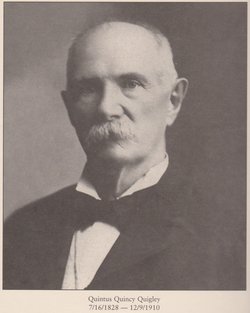
Once a strong supporter of Unionism, Quintus Quigley of Paducah (above) became a proponent of secession following President Lincoln’s call for Kentucky troops to wage a war against the South.
When news reached the Jackson Purchase of Abraham Lincoln’s victory, William Pirtle of Graves County recorded in his diary, “Excitement became intense and increased every day in the South as the idea of the loss of property of slaves did not set well.” Another Graves Countian, Eliza Gregory depicted the atmosphere to a relative in a letter when she wrote, “Nothing but uproar over the election of Lincoln and talk of fighting in the Union.” As the winter began, partisan Breckinridge voters across the South began fanning the flames of secession, and on December 20, 1860, the state of South Carolina became the first to take action by adopting an ordinance of secession from the United States. “The United States is hereby dissolved,” the ordinance declared and South Carolina’s act was hailed by secessionist supporters in the Jackson Purchase. Paducah Herald editor, John C. Noble used his newspaper as an organ for the secessionist movement and tensions became so high in Paducah, that an effigy of Noble was hung from a telegraph on the corner of Locust and Broadway streets with a sign reading, “the fate of a disunionist.” Tensions were running high as fellow neighbors were preparing for an all-out conflict.
Though the Purchase was dominated by secessionist feelings, small pockets of Unionist support could be found throughout the area with Paducah being the largest mostly due to its Whig Party heritage. The tiny hamlet of Millburn in Ballard County (now Carlisle County) was a conclave of Union support due in large part to the migration of residents from Unionist counties in central Kentucky. The Harvey section of Marshall County included a small pocket of Union support as it was to Wiley Waller, a War of 1812 veteran who served a term as state representative. According to a biographical sketch of Waller published in Histories & Biographies of the Jackson Purchase of Kentucky, Waller “was a warm opponent of secession, and in consequence of his stern adherence to what he believed to be right, he became very unpopular with those who sympathies were on the opposite side of this great question.” Waller’s influence in his home community was great enough to keep the precinct in Union support. Waller would raise a company of men for Federal service during the war which included his three sons. One son, Benjamin Waller, would be interned as a prisoner of war at the infamous Andersonville camp.
Believing the government of the United States was broken, Kentucky’s First District Congressman Henry C. Burnett became a vocal proponent of secession and advocated for his native state to follow South Carolina in aid of her “sister southern states.” In an editorial in the Paducah Herald, Congressman Burnett urged the legislature to convene at once so “so the sovereign voice of Kentucky could be heard in the momentous crisis.”
As pressures mounted, Kentucky Governor Beriah Magoffin, a states’ rights Democrat, called a special session of the General Assembly on January 17, 1861 to address the sectional crisis and Kentucky’s future. By this time, the states of Mississippi, Florida, and Alabama had seceded and Georgia, Louisiana, and Texas would follow by February. A group of secessionist legislators in the Kentucky legislature formed the Southern Rights wing of the Democratic Party in an effort to vote Kentucky out of the Union. The Purchase area’s delegation in the General Assembly aligned with the Southern Rights wing and included Representatives Thomas L. Goheen of Marshall County, Virgil Coleman of Calloway County, John Cook of Graves County, Lawrence Husbands of McCracken and Ballard Counties, and William L. Lannom of Fulton and Hickman Counties. On the Senate side, senators John M. Johnston of McCracken and Marshall Counties, John L. Irvan of Calloway County, and Samuel L. Jenkins of Graves, Fulton, Hickman, and Ballard Counties. The General Assembly was controlled by the Democratic Party who had a fifty-nine to forty-one majority in the House of Representatives and twenty-four to fourteen in the Senate. The Unionist minority in the General Assembly formed the “Opposition” Party with a main goal of blocking Governor Magoffin from calling a special session of the General Assembly due to fears of a move by the Southern Rights members in provoking secession.
But as the days went on, calls for secession became louder in far western Kentucky. “Why in God’s Name should Kentucky hesitate to come forward and place herself side by side with her sister states of the South, to whom she is allied by every consideration of interest and patriotism?,” wrote Alfred Johnson of Marshall County in a letter to the Paducah Herald. The editor of Columbus Crescent in Hickman County professed, “The Rubicon is crossed and Kentucky may as well prepare immediately to go with the Southern States into a separate Confederacy.” The Columbus Crescent was not the only Purchase newspaper beating the drums of disunion prompting Unionist John Eaker of Paducah to pen a letter to Senator John J. Crittenden in which he reported, “Every newspaper we now have in the Congressional District One believe are for disunion and their statements are all directed to that end.” The Purchase area was becoming more and more secessionist as the sectional crisis marched toward war.
By February of 1861, the Confederate States of America was officially established in Montgomery, Alabama, and Kentucky native Jefferson Davis was elected president. A few weeks later, on March 4. 1861, Abraham Lincoln was inaugurated as President of the United States, and in his inaugural speech declared he had no plans to end slavery in the states where it already existed, but he would not allow the secession of the Southern states. On April 2, 1861, former Vice President and presidential candidate John C. Breckinridge delivered a speech before the Kentucky General Assembly where he argued that states had the right to secede,. “I hold the theory of the Kentucky resolutions which I believe have been indorsed and approved by the great majority of all political parties at one time or another–that the Federal Government is a compact government between the states.”
As the fires of secession spread in the Purchase, the rest of Kentucky was experiencing a Union fever. Historian Berry Craig attributes loyalties in the 1860 presidential election as an indicator of where people stood on the sectional crisis. “While Kentucky went for Bell, the Purchase went for Breckinridge. The Breckinridge Democrats formed the nucleus of the secessionist or Southern Rights Party in every region of the state. On the other hand, the Bell and Douglas men became the backbone of the Union party everywhere except the Purchase. Here, most Bell and Douglas partisans became Southern Rightists.”
On April 12, 1861, General P.G.T. Beauregard ordered the South Carolina militia to fire upon Fort Sumter in the Charleston Harbor. The fort had been under siege by the militia who ordered Federal forces to leave. U.S. Major General Robert Anderson refused the orders and a standoff ensued. When President Lincoln announced a plan to resupply the fort, General Beauregard responded that any attempt to resupply the fort would be considered an act of aggression and he demanded General Anderson surrender. When Anderson refused to surrender, General Beauregard opened fire on the fort just before dawn. The sectional crisis had come to war.
As news reached the Purchase of the outbreak of war, R.B.J. Tyman, a Union leader in Paducah commented that following Fort Sumter, Unionist feelings began to give way to a strong Southern sympathy among the Jackson Purchase Unionist minority, “There were not half a dozen out-spoken secessionists in Paducah, but as state after state went out and took their stand by the side of South Carolina, the secession element gained strength, and one by one the people turned over to the side of the Confederacy.”
President Lincoln called for troops from each state to deal with the impending crisis and Kentucky Governor Magoffin responded insolently, “I say, emphatically, Kentucky will furnish no troops for the wicked purpose of subduing her sister Southern states.” Magoffin was soon distrusted by Unionists in the state which led to a period of gridlock in state government. In order to avoid political turmoil in an already deeply divided state, Magoffin resigned his office in 1862 and was replaced by Unionist James Robinson.
On May 16, 1861, the General Assembly officially adopted a declaration of neutrality for the state of Kentucky in response to the firing on Fort Sumter by Confederate troops. The measure was supported in every region of the state except the Jackson Purchase which demanded to leave the Union to stand beside the Southern Confederacy.
In his diary, Quintus Quigley wrote that Lincoln’s request for 75,000 Kentucky troops was a clear declaration of war against the South. Quigley also noted that Lincoln’s troop request had drastically cast the once-Whig town of Paducah into the Confederate cause. “The news spread like leaping flames over our city,” Quigley wrote, “and the same day no longer saw us divided but all united in rejecting Lincoln and his government.” Quigley reported great excitement in the city as secession flags were soon raised over public buildings and dwellings.
Formerly a strong Union man, Quigley had slowly come to believe Kentucky had the right to leave the Union and join the other Southern states in a confederacy. Quigley believed the United States government had “proven a failure” and leaving the Union “would forever settle the question of slavery.” As the spring of 1861 came to a close, the residents of the Jackson Purchase had their eye on a Union exit and they were willing to go with or without the rest of the state.